

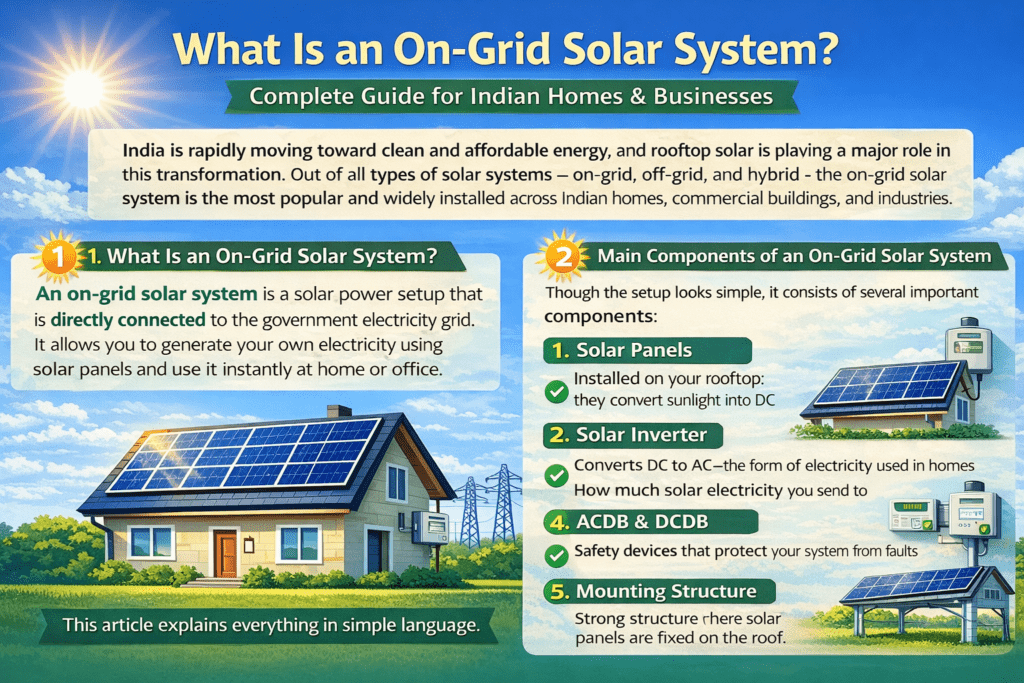
India is rapidly moving toward clean and affordable energy, and rooftop solar is playing a major role in this transformation. Out of all types of solar systems—on-grid, off-grid, and hybrid—the on-grid solar system is the most popular and widely installed across Indian homes, commercial buildings, and industries.
But what exactly is an on-grid solar system?
How does it work?
What are the benefits, costs, and real savings?
This article explains everything in simple language.
🌞 1. What Is an On-Grid Solar System?
An on-grid solar system is a solar power setup that is directly connected to the government electricity grid. It allows you to generate your own electricity using solar panels and use it instantly at home or office.
If your solar panels generate more electricity than you need, the extra power is automatically sent to the grid.
In return, you get credits on your electricity bill through a system called Net Metering.
This makes on-grid solar the most economical and practical solution for households and businesses.
🌞 2. Main Components of an On-Grid Solar System
Though the setup looks simple, it consists of several important components:
✔ 1. Solar Panels
Installed on your rooftop, they convert sunlight into DC electricity.
✔ 2. Solar Inverter
This converts DC to AC—the form of electricity used in homes.
✔ 3. Net Meter (Bi-Directional Meter)
It measures:
- How much electricity you consume from the grid
- How much solar electricity you send to the grid
✔ 4. ACDB & DCDB
Safety devices that protect your system from faults.
✔ 5. Mounting Structure
Strong structure where solar panels are fixed on the roof.
These components together create a seamless power generation and consumption system.
🌞 3. How Does an On-Grid Solar System Work? (Simple Flow)
The working is extremely simple and automatic:
Step 1 — Solar panels absorb sunlight
Panels convert sunlight into DC electricity.
Step 2 — DC goes to the inverter
The inverter converts DC to AC electricity.
Step 3 — AC electricity powers your home
Your home appliances use solar power first.
Step 4 — Extra power goes to the grid
If your home doesn’t consume all the power, the extra units go to the grid.
Step 5 — Net Metering gives bill credits
At the end of the month:
Imported Units – Exported Units = Final Bill
This is how many homes achieve zero or near-zero electricity bills.
🌞 4. Who Should Install an On-Grid Solar System?
On-grid solar is perfect for:
- Homes with reliable electricity supply
- Commercial buildings
- Schools & colleges
- Shops & showrooms
- Petrol pumps
- Factories & warehouses
- Hospitals & clinics
It is not recommended for remote areas where power cuts are frequent because on-grid systems do not work during power outages (for safety reasons).
🌞 5. Benefits of On-Grid Solar System
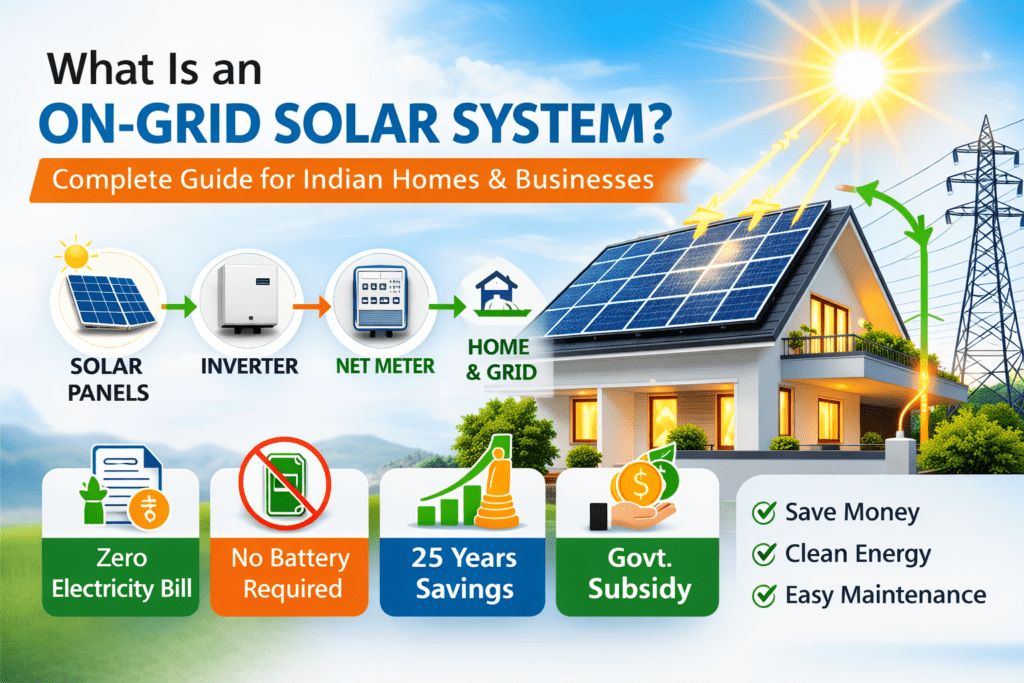
⭐ 1. Zero Electricity Bill
If your solar system generates more units than you consume, your electricity bill becomes zero.
This is the biggest reason why people choose on-grid systems.
⭐ 2. No Battery Required
Unlike off-grid systems, there are no batteries, which reduces:
- Cost
- Maintenance
- Replacement expenses
⭐ 3. Easy to Maintain
Only panel cleaning is required—no major maintenance.
⭐ 4. Best Return on Investment
On-grid solar gives savings for 25 years.
Typical payback period is 3–5 years.
⭐ 5. Government Subsidy Available
Under the new solar rooftop scheme, Indian homeowners get subsidy on on-grid systems.
⭐ 6. Helps You Earn from Extra Production
If your panels generate more than your consumption, you can export and get credits.
⭐ 7. Protects You from Rising Electricity Tariffs
Every year electricity prices increase by 5–8%.
Solar protects you from this for the next 25 years.
🌞 6. Disadvantages of On-Grid Solar
To make a fair comparison, here are the limitations:
❌ Doesn’t Work in Power Cuts
Since it relies on the grid, it shuts down during outages.
❌ Requires Net Metering Approval
Some states take time for permission.
❌ Not Suitable for Remote Villages
Only works where grid supply is reliable.
Even with these limitations, on-grid solar remains the most economical choice.
🌞 7. How Much Does an On-Grid Solar System Cost in India?
Cost depends on:
- System size (kW)
- Brand of panels (Mono PERC, TOPCon, Bifacial)
- Type of inverter
Approximate cost range (after subsidy):
- 1kW → ₹55,000 – ₹65,000
- 2kW → ₹90,000 – ₹1,10,000
- 3kW → ₹1,35,000 – ₹1,60,000
- 5kW → ₹2,25,000 – ₹2,60,000
- 10kW → ₹4,40,000 – ₹5,20,000
These prices vary by state and brands.
🌞 8. Real Savings Example
Let’s take a typical home in India:
Monthly consumption: 250–300 units
To eliminate this bill, a 3kW–5kW on-grid system is enough.
A 5kW system:
- Produces around 22–25 units/day
- Saves ₹2,500–₹3,000/month
- Saves ₹30,000–₹35,000/year
Over 25 years, savings = ₹7 lakhs to ₹10 lakhs
This makes on-grid solar one of the best investments a household can make.
🌞 9. Maintenance Requirements
Maintenance is very easy:
✔ Clean the panels 2–3 times a month
Dust reduces generation.
✔ Check inverter once every 6 months
Most modern inverters have apps for tracking.
✔ Professional inspection once a year
To ensure wiring and components are healthy.
There are no moving parts, so the system works smoothly for decades.
🌞 10. Final Conclusion
An on-grid solar system is the most efficient and affordable solar solution for Indian homes and businesses. It connects directly to the electricity grid, requires no batteries, reduces your monthly bill, and gives you clean energy for the next 20–25 years.
With government subsidies and rising electricity costs, this is the best time to switch to on-grid solar.