

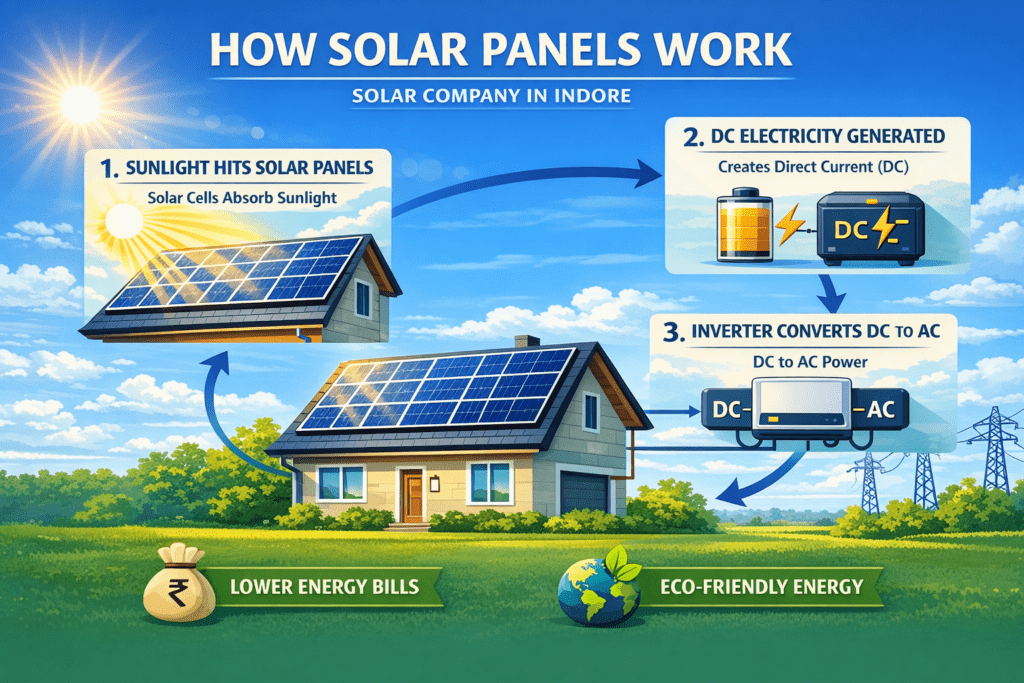
In the last few years, India has seen a massive shift toward solar energy. Rising electricity bills, increasing awareness about renewable energy, and government support for rooftop solar have encouraged homeowners and businesses to consider solar panels as a long-term solution. But one question remains constant: How do solar panels actually work?
In this article, we break down the working process of solar panels in the simplest way possible—no technical jargon, no confusing diagrams—just a clear explanation of how sunlight becomes usable electricity.
🌞 1. What Are Solar Panels Made Of?
Solar panels are made of many small units called solar cells, and most solar cells are made of silicon—a natural element found in sand and rocks. Silicon is special because it has the ability to convert sunlight into electricity.
Each solar panel contains:
- A glass layer (protection)
- Solar cells
- Conductive wires
- A metal frame
- A backsheet (insulation)
These components work together to capture sunlight and convert it into electrical energy.
🌞 2. The Scientific Principle Behind Solar Panels
Solar panels work on a scientific effect called the Photovoltaic Effect (PV Effect).
Here’s what happens:
- Sunlight hits the solar cells.
- The energy in sunlight excites electrons inside the silicon cells.
- These electrons start moving.
- Movement of electrons = electricity generation.
This electricity is in the form of DC current (Direct Current).
However, our homes and appliances use AC current (Alternating Current).
So, we need one more component…
⚡ 3. Role of the Solar Inverter – The Heart of the System
After solar panels produce DC electricity, it flows into a device called an inverter.
The inverter converts DC into AC so that:
- Your home appliances can use it
- You can send extra electricity back to the grid (in on-grid systems)
Types of inverters:
- String Inverter
- Microinverter
- Hybrid Inverter
Most Indian homes use string or hybrid inverters.
🌞 4. On-Grid vs Off-Grid – Power Flow Explained
The working flow of solar panels depends on whether you have an on-grid, off-grid or hybrid system.
A. On-Grid Solar System (Most Popular in India)
This system is connected to the government electricity grid.
Flow of power:
- Sunlight → solar panels → inverter
- Inverter converts DC to AC
- Electricity is first used by your home
- Extra electricity goes to the grid and you get credit through net metering
Benefits:
- No batteries required
- Highest efficiency
- Cheapest system
- Best for reducing monthly electricity bills
B. Off-Grid Solar System
This system works without any grid connection and uses batteries.
Flow of power:
- Sunlight → solar panels
- Panels → charge controller → batteries
- Batteries → inverter → home appliances
Useful in:
- Villages
- Remote areas
- Places with frequent outages
C. Hybrid Solar System
This system combines the best of both:
- Works with grid
- Works with batteries
- Stores extra energy
This is the most advanced but also the most expensive option.
🌞 5. What Happens When There’s No Sunlight?
This depends on the system type you choose:
- On-grid system: You automatically take electricity from the grid
- Off-grid system: You use stored electricity from batteries
- Hybrid system: You use either batteries or grid depending on availability
So, solar works even during:
- Night
- Cloudy days
- Rainy season
As long as you have grid or batteries.
🌞 6. Net Metering – The Real Game Changer
If you install an on-grid system, you get a net meter.
What it does:
- When solar produces more energy → exports to grid → you get credit
- When you need more power → imports from grid → consumes credit
At the end of the month, you pay only for:
Imported units – Exported units = Final Bill
In many cases, homeowners pay ₹0 electricity bill or “minimum bill only”.
🌞 7. Real-Life Example (Indian Household)
Let’s say your home has:
- 5kW solar system
- Daily consumption: 18–20 units
- Daily production: 22–25 units
Your home uses 18 units
Extra 4–5 units go to the grid
If your grid consumption during night = 4 units
Then your monthly bill:
(Night units 4) – (Daytime export 4) = Zero Bill
This is how thousands of Indian families are becoming bill-free.
🌞 8. Common Misconceptions About Solar Panels
❌ “Solar doesn’t work during cloudy weather.”
✔ Solar still produces 10–25% power even on cloudy days.
❌ “Solar panels damage the roof.”
✔ Professionally installed systems protect the roof and increase lifespan.
❌ “Solar is very expensive.”
✔ With subsidies and zero-maintenance operation, solar pays for itself in 3–5 years.
🌞 9. Why Solar Panels Are a Great Investment
- Reduces electricity bills by 80–100%
- Increases home value
- Zero maintenance
- Works for 25 years
- Protects you from rising power tariffs
- Environment-friendly
With growing demand, India is becoming a global leader in solar energy.
🌞 10. Final Conclusion
Solar panels convert sunlight into electricity using the Photovoltaic Effect. The electricity generated passes through an inverter, which makes it usable for homes. Depending on your system type (on-grid, off-grid, hybrid), you can reduce or completely eliminate your electricity bill.
With falling prices and rising consumption, rooftop solar is no longer a luxury—it is the smartest, most profitable investment for every Indian homeowner.