
Off-Grid Solar System: A Complete Guide for Rural Homes, Shops & Remote Areas in India

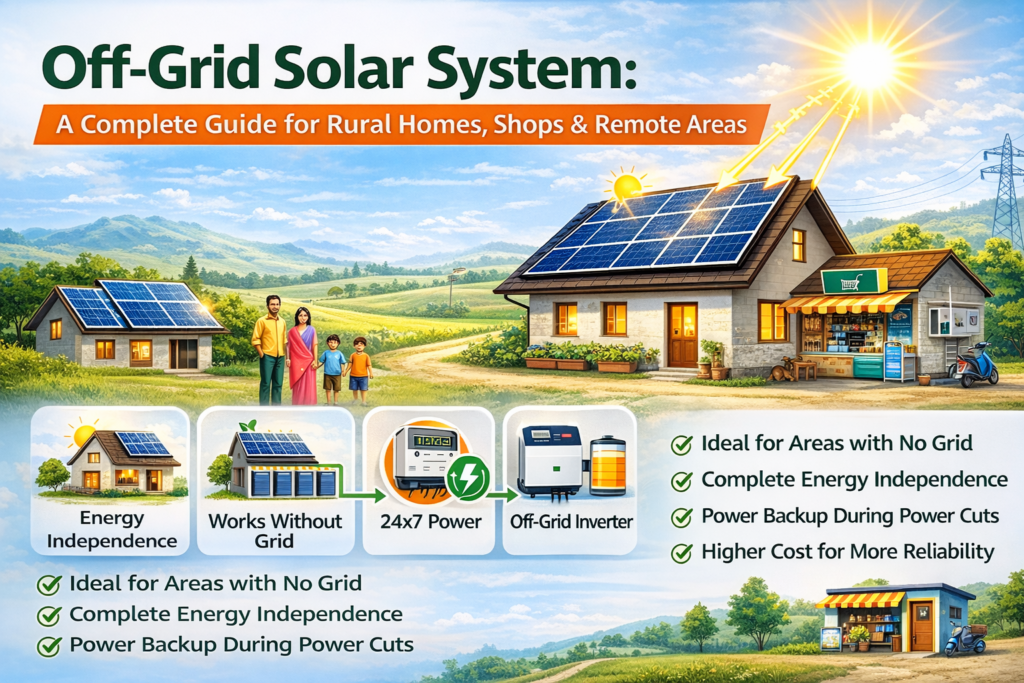
While on-grid solar systems are extremely popular in urban areas, many Indian households and businesses in remote places cannot depend on the grid due to frequent power cuts or no grid connection at all.
For them, an off-grid solar system is the best solution to achieve complete energy independence.
This detailed guide explains what an off-grid solar system is, how it works, where it is used, and how much it costs. If you are planning solar for rural, remote, or semi-urban areas, this article will help you make the right decision.
🌞 1. What Is an Off-Grid Solar System?
An off-grid solar system is a solar power setup that operates without any connection to the electricity grid.
Instead of sending excess power to the grid, it stores electricity in batteries.
This makes it ideal for places where:
- There is no grid connectivity
- There are long and frequent power cuts
- Electricity supply is unreliable
- Users need 24×7 electricity without interruptions
In simple words, an off-grid system gives you complete independence from the electricity board.
🌞 2. Key Components of an Off-Grid Solar System
An off-grid solar system includes more components compared to an on-grid system.
✔ 1. Solar Panels
Capture sunlight and convert it into DC electricity.
✔ 2. Charge Controller
Protects batteries from overcharging or deep discharge.
✔ 3. Solar Batteries
Stores electricity generated during the day for use at night or during power cuts.
✔ 4. Off-Grid Inverter
Converts DC to AC and manages battery charging/discharging.
✔ 5. ACDB & DCDB
Safety boxes to protect your system from voltage fluctuations.
✔ 6. Mounting Structures
Hold solar panels on the rooftop or ground.
These combined components ensure that the system can function even with zero grid support.
🌞 3. How Does an Off-Grid Solar System Work? (Simple Flow)
The working process can be explained in 5 simple steps:
Step 1 — Solar panels generate DC electricity.
Sunlight hits the panels, and they convert it into electrical energy.
Step 2 — Charge controller regulates the power.
It ensures batteries are safely charged without overheating.
Step 3 — Batteries store the electricity.
Excess power generated during the day gets stored.
Step 4 — Inverter converts DC to AC.
Now electricity becomes usable for home appliances.
Step 5 — Power supply during night or power cut.
Whenever there is no sunlight, electricity comes from batteries.
This is why off-grid systems are also called battery-based systems.
🌞 4. Where Are Off-Grid Systems Mostly Used in India?
✔ Rural Homes with no electricity connection
✔ Shops & small businesses in remote areas
✔ Farmhouses & agricultural lands
✔ Temples & schools in villages
✔ Mobile towers in remote areas
✔ Petrol pumps in highways
✔ Construction sites
✔ Border areas or hilly regions
Basically, any place where electricity is unreliable benefits greatly from off-grid solar.
🌞 5. Advantages of Off-Grid Solar Systems
⭐ 1. Works Without Electricity Grid
Perfect for remote locations or frequent power cut zones.
⭐ 2. Complete Power Backup
Batteries ensure uninterrupted electricity supply.
⭐ 3. Zero Electricity Bill
You are not dependent on the grid at all.
⭐ 4. Energy Independence
You control your own power generation and usage.
⭐ 5. Useful During Emergencies
Natural disasters or grid failure do not affect your electricity supply.
🌞 6. Disadvantages of Off-Grid Solar Systems
❌ Higher Cost
Because of batteries, it is more expensive than on-grid systems.
❌ Battery Replacement Every 4–6 Years
Adds to maintenance cost.
❌ Limited Backup Based on Battery Size
Once battery is discharged, you must wait for sunlight.
❌ Not Suitable for Heavy Loads
Unless you choose a very large battery bank, heavy appliances (AC, heaters) may not work efficiently.
🌞 7. How Much Does an Off-Grid Solar System Cost in India?
Cost depends on battery type, system size, and panel type.
🔋 Battery Types Available
- Lead-Acid
- Tubular Batteries
- Lithium Batteries (latest & best)
💰 Approximate pricing for off-grid systems:
- 1kW → ₹90,000 – ₹1,20,000
- 2kW → ₹1,40,000 – ₹1,80,000
- 3kW → ₹2,10,000 – ₹2,60,000
- 5kW → ₹3,50,000 – ₹4,50,000
- 10kW → ₹6,80,000 – ₹9,00,000
Lithium battery-based systems are more expensive but offer better performance and longer life.
🌞 8. How Long Do Batteries Last?
Battery life depends on:
- Type of battery
- Number of charging cycles
- Temperature
- Usage pattern
✔ Lead-acid batteries: 3–4 years
✔ Tubular batteries: 5–6 years
✔ Lithium batteries: 10–12 years
Lithium batteries are the best for long-term usage.
🌞 9. Real-Life Example of Off-Grid Usage
Let’s say a rural shop needs:
- Fan
- Lights
- Mobile charging
- Mini fridge
Daily consumption: 5–7 units
A 2kW off-grid system with a good battery setup can easily power this load without interruptions.
For a small home with:
- 4–5 fans
- 8–10 lights
- TV
- Mobile charging
- Water pump (optional)
A 3kW–5kW off-grid system is ideal.
🌞 10. Who Should Prefer Off-Grid Solar?
Choose off-grid solar if:
- You live in a village with no electricity connection
- You face long (8–10 hours) power cuts
- Your work requires 24/7 power supply
- You want full energy independence
- You want to power a remote site or farmhouse
If you live in a city with good grid connectivity, on-grid solar is a better choice.
🌞 11. Maintenance Needed for an Off-Grid System
✔ Clean panels 3–4 times a month
Batteries need proper charging to avoid power shortage.
✔ Check battery water levels (for lead-acid)
Twice every month, fill distilled water.
✔ Keep batteries in a ventilated area
Heat reduces battery life.
✔ Annual professional maintenance
To inspect connections, inverter, and safety devices.
🌞 12. Conclusion
An off-grid solar system is the perfect solution for areas with unreliable or no grid connectivity. It provides complete power independence, stores energy in batteries, and ensures 24/7 electricity. Although the initial investment is higher due to batteries, the long-term benefits—especially for rural homes, shops, and remote applications—are substantial.
If you are looking for a reliable system that works even during power cuts, off-grid solar is the best choice.